
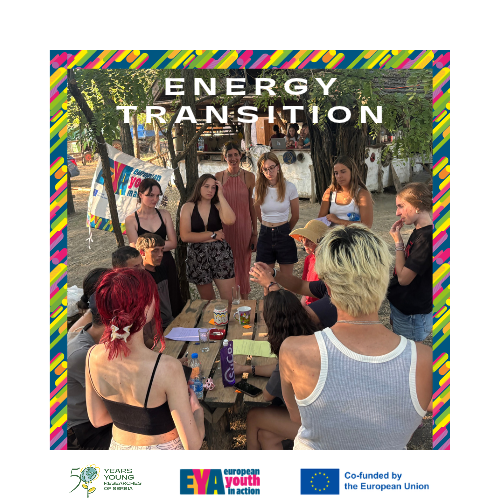
How do renewable energy technologies work? Is every technology labelled as “green” truly sustainable? And how can we ensure that the energy transition is fair and accessible to everyone? Participants explored these questions during workshops organised by Young Researchers of Serbia within two international workcamps held in Idvor and Orom.
Through interactive workshops, creative exercises and structured discussions, participants explored key energy transition concepts, renewable energy technologies and the challenges associated with their implementation. Particular attention was given to the roles of individuals, civil society organisations, national governments and the European Union in building a sustainable and just energy system.
The workshops used non-formal education methods to encourage active participation, critical thinking and the exchange of experiences. During “Energy Transition Speed Networking”, participants explored key energy-related concepts through associations and pantomime, making complex terminology more accessible and creating an engaging environment for learning.
In “Drawing Renewable Energy”, four groups explored how solar, wind, ocean and biomass energy generate electricity. By illustrating the different stages of energy production, participants tested their understanding of renewable technologies, while facilitators provided additional explanations and addressed any misconceptions.
Another key activity, “Questioning Green Technologies”, involved structured debates on the advantages and disadvantages of solar panels and electric vehicles. The discussions highlighted that technologies labelled as green are not automatically sustainable in every context. Participants examined their wider environmental and social impacts, including the extraction of raw materials needed for their production. The example of lithium mining in Africa raised questions about whether the sustainability of electric vehicles can be assessed without considering the impacts of their entire production process.
The final activity, “Energy Transition Around the World”, provided an opportunity to exchange experiences from participants’ home countries. They discussed progress, challenges, public attitudes and changes they had observed in their communities. The exchange highlighted differences between national contexts, as well as the importance of transparent communication, accessible information and public participation in shaping the energy transition.
The Energy Transition Must Also Be Just
Throughout the workshops, participants emphasised that the energy transition should not be understood solely as a technological or economic process. It must also address environmental protection, economic development, social justice and the needs of local communities.
Particular concern was raised about the limited involvement of young people in decisions concerning energy and climate policies. Participants highlighted the feeling that decisions affecting their future are often made without their meaningful participation, as well as the emotional consequences of environmental degradation and ecosystem destruction.
As individual contributions to the energy transition, participants proposed reducing electricity consumption, using energy-efficient appliances, minimising waste and adopting more sustainable transport options, including walking, cycling, public transportation and carpooling. They also highlighted the importance of adopting renewable energy solutions where possible and supporting environmentally responsible businesses.
Participants called on civil society organisations to play a more active role in environmental education, public awareness campaigns and workshops, supporting energy-poor households and monitoring the implementation of energy policies. Cooperation with schools, universities and local communities, alongside advocacy for transparent and inclusive decision-making, was also emphasised.
Recommendations for governments and the European Union included increasing investment in renewable energy and research into new technologies, providing financial incentives for households, reducing dependence on fossil fuels and ensuring accessible information about the benefits and challenges of different energy sources. Participants also stressed that environmental protection must be prioritised alongside economic development and that young people must have meaningful opportunities to contribute to policymaking.
“Renewable energy is an investment in tomorrow, not a cost of today.”
The workshops enabled participants to strengthen their understanding of renewable energy technologies and explore the energy transition from environmental, social and economic perspectives. Their discussions demonstrated that a sustainable energy system requires more than technological innovation and emissions reduction: it also depends on social justice, responsible resource management and active citizen participation.
Because the energy transition is not simply about changing how we produce energy – it is a collective process of shaping a healthier, fairer and more sustainable future.
About project
Workshops at international volunteer camps were held as part of the EYA – European Youth in Action project, which aims to empower young people across Europe to participate in discussions and decision-making on issues of climate justice. The project specifically deals with energy transition, greenwashing and biodiversity protection.


